Community
10 min read
How to Design Wholesome Events for Affinity and Special Communities (In the AI Age)
Community events feel different when people feel seen. Explore practical ways to design inclusive gatherings around belonging, accessibility, participation, and the needs of the community

A community event isn't inclusive simply because everyone is invited.
For affinity-based and special-interest communities, the details matter. Who feels represented? Who feels comfortable participating? Does the space reflect the community's needs? Is there room for people who want to connect, and room for those who need a break?
This is where culturally responsive event design matters.
Research from Stanford's d.school, studies on perceived emotional synchrony, and real-world initiatives such as NYU IRL, Yale's Offline Oasis, the University of Alabama's Tech-Free Thursdays, and Tilburg's Off the Radar all point to the same lesson: connection benefits from intentional design.
In this guide, we'll look at how to:
Design around the community, not assumptions
Use the Liberatory Design Cycle
Create spaces that support participation
Build connection without forcing conformity
Turn community feedback into better events
Why Affinity-Centered Event Design Matters
Standard event planning usually starts with logistics:
How many people are coming?
How much space do we need?
What time should the event start?
Those questions matter, but they don't tell you whether people will feel comfortable once they arrive.
Affinity communities often have their own histories, preferences, barriers, and expectations. A generic event template might overlook all of them.
A more responsive approach starts by asking what helps people feel recognized and able to participate on their own terms.
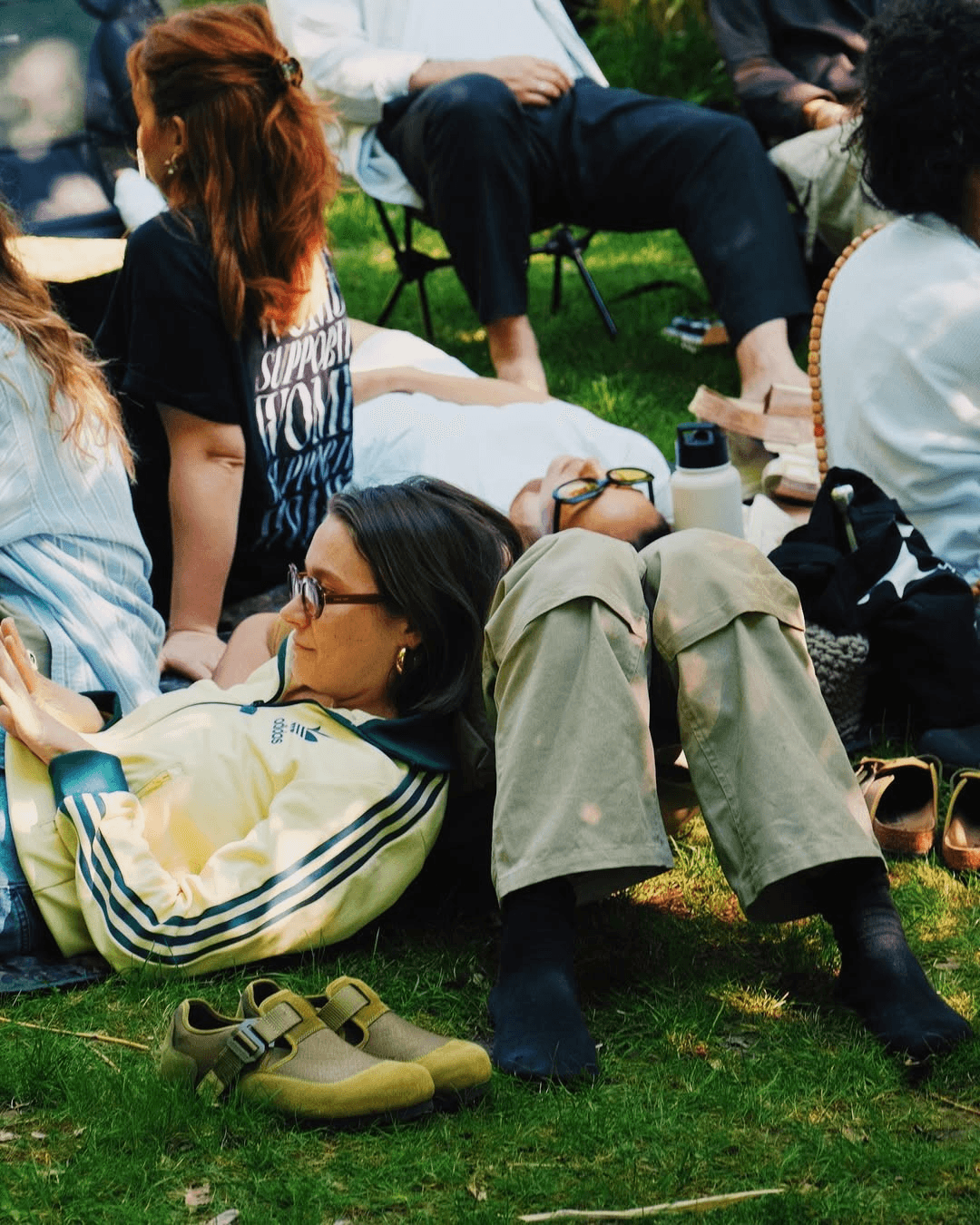
Research on perceived emotional synchrony gives us one useful piece of the puzzle. A 2015 study published in the Journal of Personality and Social Psychology examined collective gatherings and found that perceived emotional synchrony was associated with stronger social integration, collective identity, social support, and positive social outcomes.
That doesn't mean every event needs a dramatic shared ritual. It means shared experiences matter. Your job as the organizer is to create the conditions for those experiences to happen.
Learn From Communities Already Designing for Connection
You don't need to invent every idea yourself. Several institutions and community organizers are already experimenting with ways to create more intentional offline experiences.
NYU IRL
In 2026, NYU launched NYU In Real Life (NYU IRL) across its campuses and study-away sites.
The initiative includes phone-free spaces, gatherings, and activities designed to encourage people to look up from their devices and connect in person.
The useful lesson for event organizers is simple: Design the behavior you want to encourage.
If your event is supposed to help people connect, don't leave connection entirely to chance. Create spaces, activities, and expectations that make interaction easier.
Tilburg's Off the Radar
Tilburg's Off the Radar takes a more direct approach.
It is a phone-free event built around the idea of connecting by disconnecting. Attendees store their phones and enter a space designed for music, activities, and real-world interaction, free of mobile distractions.
You don't need to make your own event phone-free. The useful question is:
What behavior do I want this environment to make easier?
Then design around that answer.
Use the Liberatory Design Cycle Before You Plan
The Liberatory Design framework from Stanford is designed for complex equity and design challenges. It asks designers to build self-awareness, examine power, and work with the people affected by the design rather than designing entirely for them.
That makes it particularly useful for affinity-centered events.
Its modes include:
Notice: Examine your position, identity, and power.
Reflect: Question your assumptions and planning choices.
Inquire: Listen to the community's experiences and hopes.
Empathize: Look for shared experiences and needs.
Define: Identify the specific challenge you're trying to address.
See the System: Consider factors such as cost, transport, accessibility, and timing.
Imagine: Explore different formats, spaces, and experiences.
Prototype: Test ideas on a small scale.
Try: Run the event, gather feedback, and adapt.
The framework is deliberately iterative. Stanford d.school describes it as a practice for putting equity values into action, shifting relationships between people with decision-making power and those affected by their decisions.
For event organizers, that changes the planning question from:
"What event should we create?"
to:
"What does this community need from us, and how should the event respond?"
Start With Your Own Assumptions
The Notice phase deserves particular attention. Before booking a venue or designing the program, ask yourself:
Am I the right person to make this decision?
How does my role affect the way people experience the space?
Is the ticket price creating a barrier?
Am I assuming people want to be photographed or posted online?
Have I asked the community what they actually need?
This exercise might change the event before you've spent anything.
For example, you might learn that attendees value privacy more than social media exposure. That affects your photography policy, content plan, registration form, and communication before the event even begins.
Design for Physical and Emotional Comfort
Where people gather affects how they participate.
Incorporate somatic and trauma-informed principles to reduce the cognitive burden on attendees who may feel pressure to adapt to dominant social norms.
You don't need to turn an event into a therapeutic environment. You do need to remove avoidable sources of discomfort.
Make Representation Visible
Look at who appears in your speakers, hosts, staff, artwork, signage, and marketing.
Representation shouldn't be an afterthought. The room should convey that the community was considered in the event's design.
Make Accessibility Part of the Plan
Accessibility belongs in the planning stage, not after the venue is booked. Consider:
Physical navigation
Seating
Pricing
Transport
Sensory needs
Communication support
Create a Third Space
The idea of a Third Space describes a space somewhere outside home and work where people gather and interact.
That space doesn't need to be expensive. It could be:
A café
Library
Studio
Gallery
Community hall
The point here is to give people somewhere they associate with being present together.
Create an Atmosphere That Supports Belonging
Susie Wise's Design for Belonging, developed through Stanford d.school, takes a useful, practical approach to belonging. Wise identifies design levers such as physical spaces that promote calm, roles that create responsibility, rituals, and systems that help people feel included.
That gives event organizers plenty to work with. Think about the room:
Does it feel comfortable?
Is the lighting harsh?
Is there somewhere to sit without being in the middle of everything?
Is the sound level comfortable?
Are there too many visual distractions?
And this is what we advocate for:
Warm, low-contrast lighting
Comfortable seating
A quieter soundscape
Natural materials
Simple tactile elements
Subtle scent where appropriate
We also recommend having sensory anchors such as chamomile or citrus, ambient instrumental sounds, wool throws, and smooth stones.
Kindly note that these are optional design ideas, not universal prescriptions. Sensory preferences differ from person to person.

Create Connection Without Demanding Conformity
This distinction matters because people want to feel part of something. They don't need to become identical to everyone else.
Research on collective gatherings has found links between emotional synchrony and stronger collective identity. But the same research also shows that high synchrony can be related to identity fusion, in which personal identity becomes strongly tied to group identity.
For organizers, the practical lesson is straightforward: Create connections without demanding conformity.
Give people permission to:
Disagree
Participate differently
Step away
Say no
Ask questions
Leave when they need to
The goal is a community where people feel connected without feeling pressured to surrender their individuality.
Give People Clear Ways to Participate
Connection doesn't happen because you've put 100 people in one room. You need to give people ways into the experience.
Run Co-Design Listening Sessions
Before the event, ask the community what they actually want.
Don't stop at: "What date works for you?"
Ask:
What would make this gathering worth attending?
What usually makes community events uncomfortable?
What would make you feel welcome?
What kind of interaction feels natural to you?
What would make you come back?
The Liberatory Design approach emphasizes listening, reflection, co-creation, and designing with people affected by the experience. Those conversations become planning inputs.
Use Low-Pressure Roles
Give people small ways to contribute. Someone might:
Welcome guests
Curate the playlist
Lead a short activity
Introduce a speaker
Facilitate a discussion
Small responsibilities give attendees agency without forcing them into high-pressure participation.
Create Opportunities for I-Sharing
I-Sharing describes moments when people realize they are experiencing something similar. You don't need a complicated exercise to create these moments.
Try prompts such as: What brought you here tonight?
Or:
What's something you've been thinking about lately that you wish you could talk about with more people?
Don't force vulnerability. Create opportunities for people to find common ground naturally.
Give People a Way to Step Away
Not everyone wants three hours of constant conversation, so build in pauses where people can step away without feeling like they've stopped participating.
This could be:
A quiet room
A reading corner
Comfortable seating away from the main activity
A low-stimulation area
Permission to step outside
Yale's Offline Oasis provides students with a dedicated, technology-free space featuring activities such as puzzles, board games, coloring, and writing.
The University of Alabama's Tech-Free Thursdays similarly offer recurring screen-free wellness breaks with activities such as journaling, reading, games, coloring, and creative projects.
Both examples point to a useful event-design principle: make quieter forms of participation legitimate.
Make Room for Disagreement
A strong community isn't one where everyone agrees, so set community agreements before the event begins.
For example:
Listen without interrupting.
Challenge ideas, not people.
Respect someone's decision not to participate.
Ask before taking photos.
Address conflict directly and respectfully.
This creates structure without demanding uniformity. It also gives facilitators something to return to when tension appears.
Belonging isn't about eliminating every uncomfortable moment.
It's about creating a space where people know how the community handles those moments.
Test the Experience Before You Scale It
Before running a large gathering, test the experience with a smaller group. Ask participants to assess:
Arrival
Venue
Schedule
Social interaction
Accessibility
Sensory comfort
Phone use
Closing experience
Stanford's design resources emphasize prototyping and iterative learning. The Liberatory Design process is designed to help teams notice, reflect, act, and adapt rather than treating the first plan as final.
You can also use these two simple exercises:
Run an Assumption Storm
Write down an assumption you've made about your attendees.
For example, Everyone wants to network. Then challenge it: What if some attendees would rather connect through a shared activity first?
That question might completely change your opening activity.
Use Picture Grids
Not everyone finds it easy to describe an experience in words. Give attendees visual options representing states such as:
Connected
Overwhelmed
Welcome
Invisible
Calm
Energized
Ask them to choose the image that best describes how the event felt.
This gives you another way to understand the attendee experience alongside your standard survey questions. We specifically recommend picture grids as a tool for making abstract emotions easier to communicate.
Build a Community, Not a One-Off Event
Your event shouldn't be the end of the relationship. Use what you learn to improve the next gathering.
Make sure you’re tracking:
First-time vs. returning attendees
Preferred event formats
Popular activities
Accessibility requests
What attendees praised
What created friction
Then use those findings to shape what's next. The Liberatory Design Cycle is useful here because it treats design as an ongoing practice rather than a one-time decision.
That creates a simple loop:
Listen → Design → Test → Gather → Improve → Repeat
That's how a single gathering becomes a community practice.
Put the Community at the Center
Good affinity-centered events aren't defined by expensive decor or a packed schedule.
They're defined by how considered the experience feels.
Listen before you design. Question your assumptions. Make accessibility part of the plan. Give people different ways to participate. Create room for connection, disagreement, and rest.
And use technology where it helps your team do those things better.
Mingloft handles the operational side of event planning, from budgets and tasks to vendors and event logistics, so your team has more space to focus on the experience you're creating.
Ready to plan more intentional community events with less operational chaos? Try Mingloft today.