Measurement
6 min read
Event Survey Questions That Actually Get Answered (+ NPS for Events)
Most event surveys get ignored because they're too long, too vague, and land too late. Here's how to write survey questions attendees actually answer, a copy-paste question bank, and how to run NPS for events properly.

You spent months on the event. You sent the feedback survey the next morning. And then: nothing. A trickle of responses, most of them blank where it mattered, and a couple of one-word answers that tell you nothing you can use.
It's not that your attendees didn't care. It's that the survey asked too much, at the wrong time, in a way that made answering feel like work. A good survey is designed to get answered, and most aren't. But we’re here to fix it. Here's how to fix that, plus the exact questions worth asking and how to run NPS properly. But first:
Why Do Most Event Surveys Get Ignored?
Four things kill response rates, and they're almost always the same four:

An attendee filling in a survey
It's too long: Every extra question costs you responses. A survey that looks like a form gets treated like one.
It's too generic: "How was your experience?" invites a shrug. Vague questions get vague answers.
It lands too late: Send it three days later, and the details have already faded. The window is hours, not days.
There's nothing in it for them: If it's not obvious, their answer will change anything; most people won't bother.
Now that we know why most surveys get no responses, let’s look into:
The Rules for Questions That Actually Get Answered
Keep it short: Aim for around five questions. That's enough to learn something real without asking for a time commitment nobody signed up for. Every question past that point, you're trading response rate for detail you probably won't act on anyway.
Only ask what you can act on: Before any question goes in, answer this: if everyone answers it, what will I do differently? If you can't name the decision it feeds, cut it. A survey is a list of decisions waiting for data, not a curiosity dump.
Open with something easy: Lead with a one-tap question, a rating, or a yes/no. Momentum matters. Once someone's answered the first thing, they're far more likely to finish. Never open with a blank text box.
Use scales, and exactly one open box: Most of your questions should be quick to tap: ratings, multiple choice, yes/no. Then give people one, and only one, open-ended question where they can say what's actually on their mind. One good text box gets thoughtful answers. Five of them get abandoned.
Send it while it's fresh: The best response rates come from asking on-site or within a few hours. A QR code on the way out, or an email that hits before they've left the car park, beats a "thanks for attending" message two days later every time.
The Event Survey Questions Worth Asking
Here's a question bank you can lift straight into your next survey. Pick five or six, not all of them.
Overall Questions:
- Overall, how would you rate the event? (1–5)
- Did the event meet the expectations you had when you registered? (Exceeded / Met / Fell short)
Content and sessions Questions:
- Which session was most valuable to you? (pick from a list)
- Was there a topic you wanted more of? (short answer, optional)
Logistics Questions:
- How easy was check-in and registration? (1–5)
- Did anything about the venue or format get in your way? (optional)
Forward-looking Questions:
- Would you attend again? (Yes / Maybe / No)
- What's the one thing we should change for next time? (open text, this is your single most useful question)
And finally, the question every one of us asks:
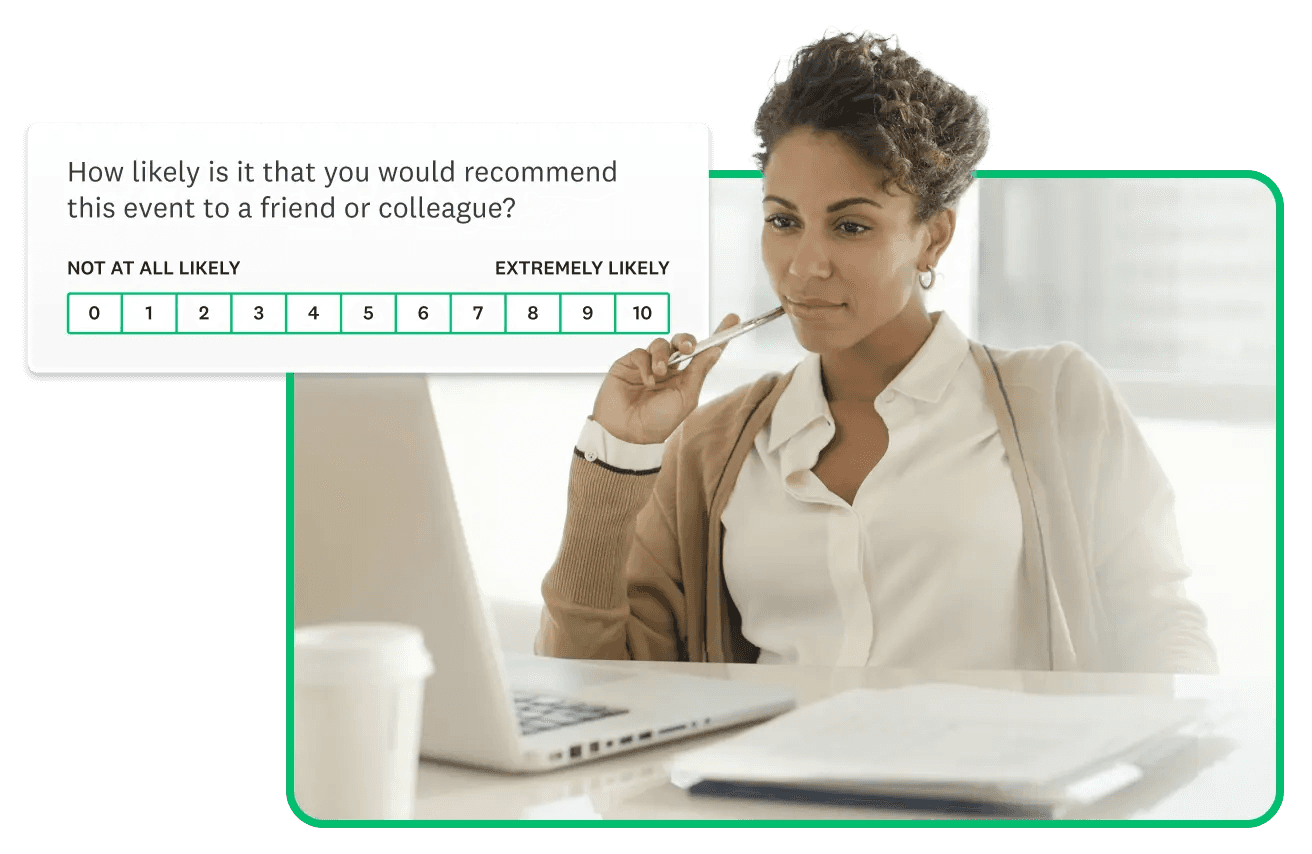
That last one earns its place. If you only kept two questions, the recommended score below, and "what should we change" would tell you most of what you need.
NPS for Events
Net Promoter Score is the single cleanest read on whether your event actually landed, which is why it's worth tracking every time. It comes down to one question: "How likely are you to recommend this event to a colleague or friend?" answered on a scale of 0 to 10.
Here’s how to score it:
Sort the responses into three groups:
Promoters (9–10): your advocates. They'll bring people next year.
Passives (7–8): satisfied but not sold. They won't spread the word.
Detractors (0–6): they left unconvinced or unhappy.
Then the formula:
NPS = % Promoters − % Detractors.
Passives don't count toward the score; they just dilute it. Say 100 people respond: 60 promoters, 25 passives, 15 detractors. Your NPS is 60 − 15 = +45.
What's a good event NPS score?
Scores run from −100 to +100. Anything positive means more advocates than critics. A score above 50 is commonly considered strong for an event, and many solid events land somewhere in the 30s and 40s.
But the number matters less than the trend: track it for every event and watch which direction it moves.

Event attendees positive reactions
The follow-up that makes NPS useful
The score alone tells you how people felt, not why. So always pair it with one open question: "What's the main reason for your score?" That single line turns NPS from a vanity number into something you can act on. A +45 with the reasons attached tells you exactly what to protect and what to fix. A +45 on its own tells you nothing you can use.
What to Do With Your Event Survey Answers
Good questions get you responses. The next job is reading them without losing an afternoon to it, especially the open-ended ones, which is where the real feedback hides. The fastest way through is to group themes and score sentiment, then act on what surfaces.
Note: This guide gives you the resources to do just that.
One thing worth simplifying: if your survey lives in one tool, your registrations in another, and your check-in data somewhere else, connecting "this person rated us a 3" to "and here's what they actually attended" turns into a spreadsheet chore.
When feedback sits in the same place as the rest of your event data, that connection is already made, and the survey is one less separate tool to wrangle.
That’s what Mingloft solves. Have all your data in one platform:
Frequently Asked Questions
How many questions should an event survey have?
Around five. Enough to learn something useful without asking for a real-time commitment. Response rate drops with every extra question, so only include ones tied to a decision you'll actually make.
When should I send a post-event survey?
As soon as possible, ideally on-site via a QR code or within a few hours by email. The longer you wait, the more the details fade and the lower your response rate.
What is a good NPS for an event?
Any positive score means more advocates than critics. Above 50 is commonly considered strong, though many good events sit in the 30s and 40s. The trend across events matters more than any single number.
What's the best single-event survey question?
"What's the one thing we should change for next time?" paired with the NPS recommended question. Together, they capture both how people felt and what to do about it.
Should event survey questions be open-ended or multiple choice?
Mostly multiple choice and rating scales, so they're quick to answer, with exactly one open-ended box for genuine feedback. Too many open questions are the fastest way to get a survey abandoned.